
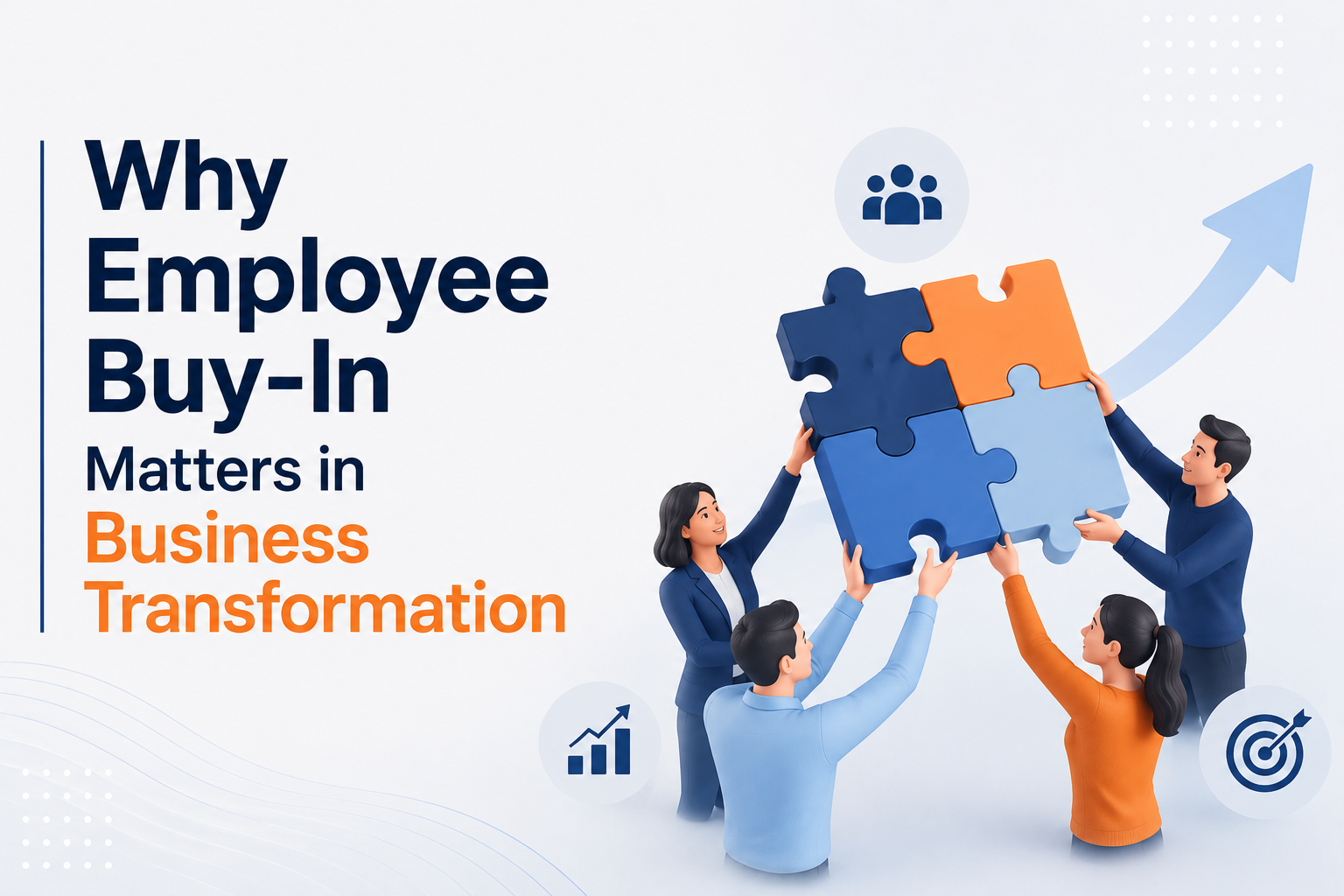
Every business transformation starts with a plan on a slide deck, new systems, new structures, new strategy. But plans don’t transform companies. People do. And if the people inside your organization aren’t genuinely bought in, even the most brilliant transformation strategy will stall in the gap between “announced” and “adopted.”
This is the uncomfortable truth most leadership teams learn the hard way:McKinsey’s Global Survey found that around 70% of organizational changes fail, largely because of employee resistance and lack of management support. That’s not a technology problem or a strategy problem, it’s a people problem. And it’s entirely preventable.
In this article, we’ll unpack why employee buy-in matters so much in business transformation, what happens when it’s missing, and how organizations can build genuine commitment rather than surface-level compliance.
What Is Employee Buy-In, Really?
Employee buy-in is more than agreement in a town hall meeting or a nodded head in a Teams call. It’s the point at which employees move from complying with a change because they were told to, to championing it because they understand and believe in why it matters.
There’s a meaningful difference between:
- Compliance – employees follow new processes because it’s mandated, doing the minimum required.
- Buy-in – employees understand the “why,” see how it benefits them and the business, and actively support the transformation, even when no one is watching.
Only compliance shows up in a rollout. Only buy-in survives the first setback.
The Real Cost of Low Employee Buy-In
Skipping buy-in doesn’t just slow a transformation down, it can quietly sink it. Here’s what the data shows:
- A McKinsey report cited by change management researchers found that only 30% of change management initiatives succeed, with the remainder undermined largely by people-related factors rather than technical ones.
- Failed transformations are commonly attributed to inadequate management support (33%) and employee resistance (39%), together accounting for the majority of failed change efforts.
- On the flip side, when employees are genuinely invested in a change effort, the likelihood of that initiative succeeding increases by roughly 30%, and involving employees directly in decision-making can lift success rates by a further 15%.
- Employees who are involved early in a transformation, rather than simply informed after decisions are finalized, tend to be less resistant, projects with strong employee buy-in see notably higher success rates, yet most organizations still announce change from the top down rather than co-creating it with their teams.
Put simply: buy-in isn’t a “nice to have” soft-skills concern. It’s one of the single biggest, most measurable levers of transformation ROI, bigger, in many cases, than the technology or strategy itself.
Why Employee Buy-In Matters So Much
1. Employees Are the Ones Who Actually Execute the Change
Leadership designs the transformation. Employees deliver it every day, in every customer interaction, workflow, and decision. A strategy that isn’t understood or embraced at the frontline simply doesn’t get executed with consistency, no matter how well it was designed in the boardroom.
2. Resistance Is Expensive and Often Invisible
Resistance rarely shows up as open rebellion. It shows up as quiet disengagement: missed deadlines, workaround habits, “we’ve always done it this way,” and a slow bleed of productivity that’s hard to trace back to its source. By the time leadership notices, months of momentum and budget, have already been lost.
3. Buy-In Builds Resilience Through Setbacks
Every transformation hits friction. Teams with genuine buy-in treat setbacks as problems to solve together. Teams without it treat setbacks as proof the change was a bad idea, and momentum collapses.
4. It Protects Culture and Trust
How a transformation is led sends a message about how much leadership values its people. Transformations pushed through without input erode trust, and that trust is far harder to rebuild than it was to lose. Conversely, transformations built with employees tend to strengthen culture, engagement, and retention.
5. It Compounds Over Time
Organizations that consistently involve their people in change build “change muscle”, the next transformation gets easier, faster, and cheaper because the workforce trusts the process. Organizations that don’t, face growing resistance with every subsequent change effort.
How to Build Genuine Employee Buy-In During Transformation
1. Communicate the “why” before the “what.” People don’t resist change itself, they resist change that feels imposed on them without context. Lead with purpose: why is this transformation happening, why now, and what happens if the organization doesn’t change?
2. Involve employees early, not just at rollout. Bring representative employees into the planning conversation. Pilot ideas with real teams before company-wide rollout. Input earlier in the process consistently correlates with stronger adoption later.
3. Give managers the tools to lead the change, not just announce it. Frontline and middle managers are the most influential voice in how a transformation is perceived. If they aren’t equipped and bought in themselves, the message breaks down before it reaches the wider team.
4. Make the transformation visible and safe to question. Create structured channels for feedback and concerns, and act on what you hear. Employees buy in faster when they see their input actually shaping the outcome.
5. Recognize and reinforce new behaviors early. Buy-in is sustained by visible wins. Celebrate early adopters, share quick wins publicly, and connect individual effort back to the bigger transformation story.
Turning Buy-In Into Business Results
Employee buy-in isn’t a soft metric to tack onto a transformation roadmap, it’s the mechanism through which every other transformation goal gets delivered, from cost savings to customer experience to digital adoption. Organizations that treat it as a core workstream, not an afterthought, are the ones that consistently land on the right side of that 70% failure statistic.
At Ethikcorp, our Business Transformation division works with organizations across industries to design change initiatives that people actually adopt, combining strategic consulting with the human side of change management. We also help build internal change capability through our Corporate Training Solutions, equipping managers and teams with the skills to lead, not just survive, transformation.
If your organization is planning a transformation and wants to get employee buy-in right from day one, get in touch with our team to talk through your goals.