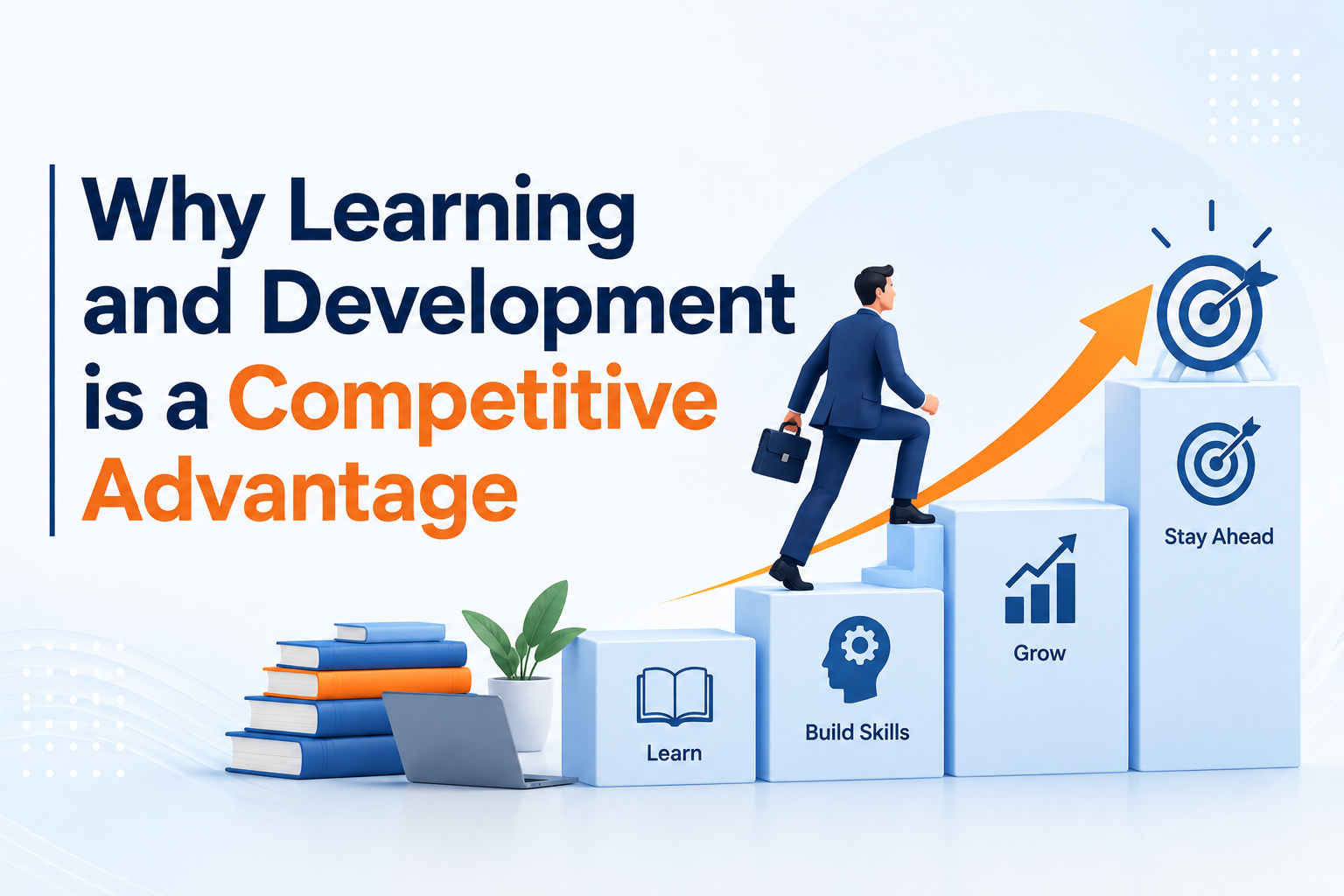
In today’s business environment, competitive advantage is no longer defined solely by technology, products, or pricing. Organizations operate in markets where customer expectations evolve rapidly, technologies advance continuously, and business models change faster than ever before. In this landscape, the ability to learn, adapt, and innovate has become one of the most valuable assets an organization can possess.
This is where Learning and Development plays a critical role.
Far beyond traditional training sessions or onboarding programs, modern learning and development equips employees with the skills, confidence, and mindset needed to navigate change, solve complex problems, and contribute meaningfully to business success. Organizations that invest strategically in employee development are better positioned to improve performance, retain top talent, strengthen leadership capabilities, and respond effectively to emerging opportunities.
Rather than viewing learning as a cost centre, forward-thinking organizations recognize it as a long-term investment that supports sustainable growth and organizational resilience.
Learning and development Used to Be a Cost Center. Now It’s a Strategic Lever
For years, training was treated as overhead: something to deliver once, check off, and move on from. That model doesn’t hold up anymore.
According to LinkedIn’s 2025 Workplace Learning Report, organizations are increasingly recognizing that the ability to build skills quickly is now central to executing business strategy, not a supporting activity around it. The report also found that nearly half of learning and talent development professionals admit their employees lack the skills needed to execute the business’s strategy effectively.
That’s a striking admission. It means a large share of organizations know they have a capability gap, and know it’s holding the business back, yet still treat L&D as optional.
The companies closing that gap are the ones redefining what learning is for. It’s no longer about compliance training and onboarding checklists. It’s about building the capability to compete.
The Real Cost of Underinvesting in Learning
Skipping investment in learning doesn’t just slow individual growth, it shows up directly in retention, performance, and competitiveness. Here’s what the research shows:
- LinkedIn Learning’s research on developing employees and improving performance has consistently found that around 94% of employees say they would stay at a company longer if it simply invested in helping them develop their careers.
- Employees who feel their skills aren’t being put to good use are roughly 10 times more likely to be job hunting than those who feel used well, a direct link between stagnation and attrition.
- Effective employee development has been shown to lift performance by as much as 25%, a gain most leadership teams would fight hard for through any other lever.
- Only around a third of organizations qualify as genuine “career development champions,” meaning they use multiple, structured tactics to support employee growth, but those that do are consistently more profitable, better at retaining talent, and quicker to adopt new technology than those that don’t.
The pattern is consistent: organizations that under-invest in learning don’t just fall behind on skills, they lose the people who could have closed the gap in the first place.
Why Learning and Development Is a Genuine Competitive Advantage
1. Skills Are Now the Scarcest Resource, Not Capital or Technology
Capital is easier to raise than ever, and most technology is available to any competitor willing to pay for it. What’s scarce is a workforce that can actually use it well. Organizations that build internal capability faster than their competitors gain an advantage that’s much harder to copy than a product feature or a pricing model. Research from the Association for Talent Development has repeatedly found that companies with comprehensive, formalized training programs generate meaningfully higher income per employee than those without one, a gap that compounds year over year.
This is closely tied to a point we’ve made before: strategy and capability only translate into results when the people executing them are genuinely invested, not just informed. We explored that dynamic in depth in why employee buy-in matters in business transformation, buy-in gets people to embrace a change; L&D gives them the actual capability to deliver it.
2. It Directly Drives Retention in a Tight Talent Market
Losing a skilled employee doesn’t just cost recruitment fees, it costs institutional knowledge, ramp-up time for the replacement, and momentum on whatever that person was driving. When employees see a real path to growth inside the organization, they’re far less likely to look for it elsewhere.
3. It Builds Adaptability, Not Just Competence
A single training program teaches a single skill. A genuine learning culture teaches people how to keep learning, which matters far more when the skills required for a role can shift within a year or two, particularly as AI reshapes how work gets done across nearly every function.
4. It Strengthens Execution, Not Just Intent
Strategy documents describe what a company wants to achieve. Capability determines whether it actually happens. An organization can have the right strategy and still fail to execute it if the workforce doesn’t have the skills to deliver it, this is exactly the gap nearly half of L&D leaders say they’re currently facing.
5. It Compounds, the Same Way Buy-In Does
Organizations that consistently invest in developing their people build a workforce that’s faster to reskill for the next shift, whether that’s a new system, a new market, or a new technology. Organizations that don’t, face the same skills gap over and over, each time starting from further behind.
How to Turn L&D Into a Real Competitive Advantage
1. Tie learning directly to business strategy.
Training that isn’t connected to where the business is headed becomes a box-ticking exercise. Start with the capabilities the strategy requires, then build learning around closing that specific gap.
2. Make development a leadership priority, not an HR initiative.
Where leadership visibly invests time and budget in learning, employees treat it as core to the job. Where it’s delegated entirely to HR, it gets treated as optional.
3. Personalize the path.
A single training deck rarely fits a diverse workforce. Structured, role-specific development, paired with mentorship and real project exposure, consistently outperforms generic, one-size-fits-all programs.
4. Build internal mobility into the model.
Employees who can see a next step inside the company are far more likely to invest in developing the skills to get there, and far less likely to look outside for it.
5. Measure impact, not just completion.
Completion rates tell you a course was finished. Performance data, retention data, and internal mobility data tell you whether the learning actually changed anything. Track the outcomes that matter to the business, not just the ones that are easiest to report.
Making Learning a Business Strategy, Not a Perk
Learning and development stops being a competitive advantage the moment it’s treated as a nice-to-have. It becomes one the moment it’s built into how the business actually operates, tied to strategy, backed by leadership, and measured against real outcomes.
The organizations winning right now aren’t waiting for a skills gap to become a crisis before they act on it. They’re building the capability to adapt before they need it.
At Ethikcorp, our Corporate Training Solutions division helps organizations design learning strategies that build real capability, not just completed courses, equipping teams and managers with the skills to perform today and adapt to whatever comes next. We also work alongside our Business Transformation division to make sure learning is built into change from the start, rather than bolted on after.
If your organization wants to turn learning and development into a genuine competitive advantage, get in touch with our team to talk through your goals.
FAQs: Learning and Development as a Competitive Advantage
Is learning and development really a competitive advantage, or just an HR initiative?
It’s both, but the businesses pulling ahead treat it as the former. When L&D is tied directly to business strategy and measured against performance and retention outcomes, it functions as a genuine driver of growth, not a supporting HR activity.
What’s the biggest ROI of investing in employee development?
Retention is usually the fastest, most measurable return. Around 94% of employees say they’d stay at a company longer if it invested in their development, and replacing a skilled employee typically costs far more than developing one in place.
How is L&D different from basic employee training?
Training teaches a specific skill for a specific task. L&D builds the broader capability to keep learning as roles and technology change, which matters more as skill requirements shift faster than most job descriptions can keep up with.
Does L&D matter more or less in the age of AI?
More. As AI reshapes how work gets done across nearly every function, the organizations that can reskill their workforce quickly are the ones that stay competitive. The ones that don’t invest in learning are the ones most exposed to disruption.
How do we measure whether our L&D program is actually working?
Completion rates alone don’t tell you much. Look instead at performance data, retention data, and internal mobility, whether employees who go through development programs perform better, stay longer, and move into new roles internally.
Where should a company start if L&D has been an afterthought?
Start by identifying the specific capability gaps holding your strategy back, not with a generic course catalog. From there, build development around closing those gaps, get leadership visibly involved, and track outcomes rather than just attendance.